The Court of Appeal has not cleared Rosmah Mansor yet. But after seven years of conviction, condemnation and social-media vilification, it has given her something fundamental: an opportunity for evidence at the heart of her case to be properly tested.
For almost seven years, Datin Seri Rosmah Mansor has lived with a public verdict.
On social media, she was not merely portrayed as a woman convicted of corruption. She became something much larger in the public imagination — the woman who had supposedly taken money meant for schoolchildren in rural Sarawak.
The story was repeated so often that the allegation became, for many, a fact.
Yet the criminal justice system does not operate on repetition.
It operates on evidence.
And that is why Tuesday’s decision by the Court of Appeal is significant.
The court has not acquitted Rosmah yet. It has not declared the new evidence to be true. But it has allowed fresh evidence from key prosecution witness Rayyan Radzwill Abdullah to be heard and tested before the High Court.
After seven years, that is no small development.
A Case Built Around Witnesses, Money And Attribution
One of the things that troubled me throughout the trial was the central role played by Datuk Rizal Mansor.
Rizal was initially charged alongside Rosmah before becoming a prosecution witness.
That transition inevitably made his evidence something that deserved particularly careful scrutiny.
The defence’s new evidence now raises questions about precisely that.
Rayyan says Rizal allegedly used the names of other public officials when seeking money from Jepak. More importantly, he says payment-related communications and alleged instructions were conveyed through Rizal, rather than directly from Rosmah.
That, on its own, does not prove Rizal lied.
But it raises an obvious question:
When a crucial allegation is communicated through an intermediary, how certain can we be that the intermediary was accurately conveying the instructions of the person he claimed to represent?
That question becomes even more important when the intermediary himself was once an accused person in the same case.
Did Rosmah Actually Receive The Money?
Another issue that has always troubled me is the evidence surrounding the alleged receipt of the RM1.5 million.
The public version of the story is remarkably simple: money was allegedly brought to Rosmah’s house.
But criminal cases are not decided by the simplicity of a story.
They are decided by what a witness actually saw, what he knows personally, and what he was told by somebody else.
The defence’s fresh evidence is significant here.
Rayyan now says he did not personally see Rizal point out or identify the bag to Rosmah, nor did he observe any reaction from her demonstrating knowledge of the bag. According to his present account, it was Saidi who subsequently told him about the money.
That creates a very important evidential question.
If a witness’s knowledge of an alleged payment comes not from what he personally witnessed, but from what another person subsequently told him, how much of the evidence is firsthand and how much is derivative?
That is not something that should be decided by social media.
It is precisely the kind of question that should be tested through cross-examination.
And now, because of Tuesday’s ruling, it will be.
The Courtroom Versus The Court Of Public Opinion
I was in court during the original proceedings.
I remember the atmosphere. I remember the way Rosmah was spoken about and spoken to.
There were moments when I was deeply uncomfortable with the manner in which the prosecution approached her, including the insistence that she be referred to as “OKT” — orang kena tuduh — rather than by her title, Datin Seri.
Of course, Rosmah was an accused person. There is nothing improper about calling an accused person an accused.
But there is a larger principle at stake.
The purpose of a trial is to determine whether an accused person is guilty — not to begin with the assumption that guilt has already been established.
That distinction matters enormously when the person being tried is already being condemned outside the courtroom.
What We Thought We Knew May Now Have To Be Examined
The new evidence from Rayyan goes beyond the question of whether he remembers events differently today.
He alleges that he was pressured and discouraged from disclosing matters he says he had previously conveyed during the investigation. His account is now contained in sworn material, and the defence points to an earlier affidavit from 2020 as part of the context.
The defence says this could affect the reliability of evidence that formed part of the basis for Rosmah’s conviction.
That is why Tuesday’s ruling matters.
The Court of Appeal has essentially said: these are questions that deserve to be heard.
Not accepted.
Not presumed to be true.
Heard and tested.
A Small Measure of Vindication
After seven years of being called every imaginable name, there is something quietly significant about that.
Rosmah has not been vindicated in the sense of being cleared.
Her conviction remains.
Her substantive appeal remains to be decided.
But Tuesday’s decision has given her something that every accused person should be entitled to: a proper opportunity to have potentially material evidence examined before the court.
And, importantly, that is how her lawyers themselves characterised it.
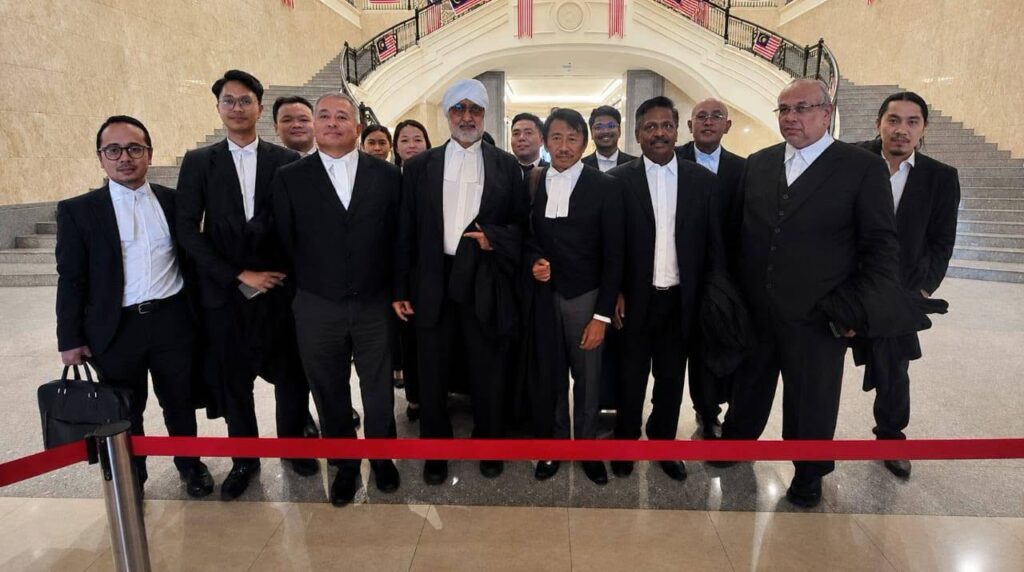
“Today justice has been served,” lead counsel Datuk Amer Hamzah Arshad said outside court.
He was not suggesting that the new evidence had already been proven. On the contrary, he acknowledged that its truthfulness and reliability would have to be tested before the High Court.
“We want it to be tested. We want it to be shown to the world” that the additional evidence is credible and reliable, he said.
That distinction matters.
The defence’s press statement made essentially the same point, describing the ruling as an important opportunity for evidence which Rosmah maintains was not properly before the original trial court to now be “heard and scrutinised in open court.” After years of litigation, the statement said, she would finally have the opportunity to have these matters tested through the judicial process.
That is not an acquittal. It is not a finding that the new evidence is true.
It is something more modest — but, after seven years, still significant.
The door has been opened for the evidence to be heard and tested.
Before we decide who is guilty, before we turn allegations into memes and memes into “facts”, perhaps we should allow the evidence to speak.
After seven years, Rosmah has been given another opportunity to do just that. – NMH
Facebook Comments

Facebook Comments