When an autistic adult goes missing, finding them is only part of the story. Understanding them is the greater challenge.
When her autistic son disappeared for several agonising hours, New Malaysia Herald Editor-in-Chief Datin Hasnah Abdul Rahman was reminded that there are no simple solutions when caring for autistic adults. In this personal reflection, she shares why well-intentioned advice often falls short and why Malaysia must move beyond awareness towards genuine understanding, compassion and inclusion.
For several agonising hours this Friday, my family searched desperately for my third son, Ahmad Ziqri, who is an autistic adult. Those were among the longest hours of my life.
Thankfully, our story ended well.
A special education teacher recognised him at a restaurant in Cheras. Her quick thinking, together with the kindness of her husband, restaurant staff, dedicated police officers, security personnel, the nearby Mall staff, residence and community groups, an extraordinary neighbour who helped us search, and countless Malaysians who shared our appeal on social media, brought Ziqri safely home.
As a mother, I will remain forever grateful.
But once the relief subsided, one thought kept returning to me: what an irony life can be.
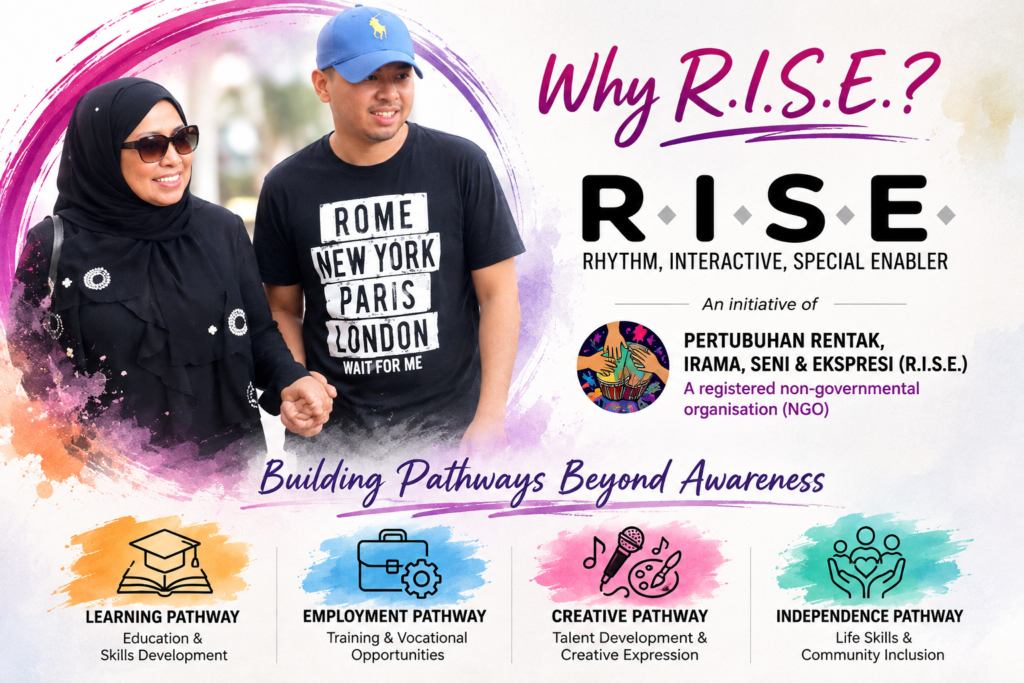
As President of Pertubuhan Rentak, Irama, Seni & Ekspresi (R.I.S.E.), a registered non-governmental organisation (NGO), I spend much of my time advocating for neurodiverse young adults and their families. Our public initiative, R.I.S.E. – Rhythm Interactive Special Needs Enabler, was established to help build pathways beyond school and beyond awareness.
Yet during those long hours, none of those titles mattered.
I was not an advocate.
I was simply a mother searching for her son. And this was not the first time it happened, perhaps, not the last.
When Advice Doesn’t Fit Reality
Almost immediately after Ziqri was found, messages of support began pouring in, together with many well-intentioned suggestions.
“Get him an AirTag.” | “Buy him a GPS tracker.” | “Make him wear an identification bracelet.” | “Print your phone number on his T-shirt.”
Every suggestion came from a place of genuine concern.
The reality, however, is that autism is never one-size-fits-all.
We have already tried AirTags.
We have tried identification bracelets.
Neither worked.
Like many autistic adults, Ziqri has strong sensory preferences. If he dislikes wearing something, he simply removes it.
Sometimes he tears up clothes he no longer wants to wear.
Sometimes he throws them into the rubbish bin.
Not only his own clothes, but occasionally those belonging to his brothers as well.
Another suggestion was to print my phone number on his T-shirts.
Again, I understand the reasoning.
But as a mother, another fear immediately crossed my mind.
What if someone with bad intentions uses that information?
What if they realise he is vulnerable?
What if they decide to exploit that vulnerability?
Parents of autistic adults constantly find themselves balancing independence with protection.
There are rarely perfect answers.
When Misunderstanding Becomes The Bigger Challenge
This was not the first time Ziqri had been misunderstood.
Five years ago, what should have been his 25th birthday ended with him spending the night in a police lock-up following an incident in which he was very much misunderstood.
It was heartbreaking for our family.
A few days later, however, something extraordinary happened.
William Cheah and Yi-Lyn Chan, together with the Kembara Kitchen team and many kind-hearted friends and supporters, organised a special birthday celebration for Ziqri at a restaurant. Guests paid to attend, while my family and I were invited to join him so he could finally celebrate the birthday he had missed.


What began as one of the saddest birthdays of his life became one of his happiest.
That evening reminded me of something I have never forgotten.
Misunderstanding can wound. But kindness has an extraordinary ability to heal.
This week, as strangers once again stepped forward to help bring Ziqri home safely, I was reminded of that same lesson.
Beyond Awareness
For almost 30 years, I have watched Ziqri grow from an autistic child into an autistic adult.
Along the way, I have learned that while autism may not change, society’s understanding of it can — and must.
Many people know about autism.
Far fewer understand autistic adults.
When school ends, life does not suddenly become easier.
For many parents, the greatest challenge begins not when their child is diagnosed, but when the structured support of childhood ends and adulthood begins.
That is one of the reasons Pertubuhan Rentak, Irama, Seni & Ekspresi (R.I.S.E.) was established by my amazing committee and team members.
Through R.I.S.E. – Rhythm Interactive Special Needs Enabler, we hope to create pathways for neurodiverse young adults to continue learning, developing their talents, finding meaningful opportunities and living with greater independence.
But organisations alone cannot build an inclusive society.
Teachers build it.
Police officers build it.
Restaurant staff build it.
Neighbours build it.
Strangers build it.
Every act of understanding becomes another step towards a more compassionate Malaysia.
A Mother’s Hope
As I watched Ziqri sleeping peacefully after finally returning home — exhausted from an adventure only he truly understands — I realised that perhaps this was never just our family’s story.
It is the story of thousands of Malaysian families raising autistic adults who continue to navigate a world that often is not designed for them.
If our experience encourages even one person to pause before judging someone who behaves differently…
If it inspires one stranger to offer help instead of looking away…
If it reminds us that kindness can make all the difference…
… then perhaps some good has already come from one of the longest days of my life.
Autism does not end at childhood. Neither should our understanding.
For one day, every autistic child will become an autistic adult. Perhaps it is time we started preparing not just them for society, but society for them. – NMH
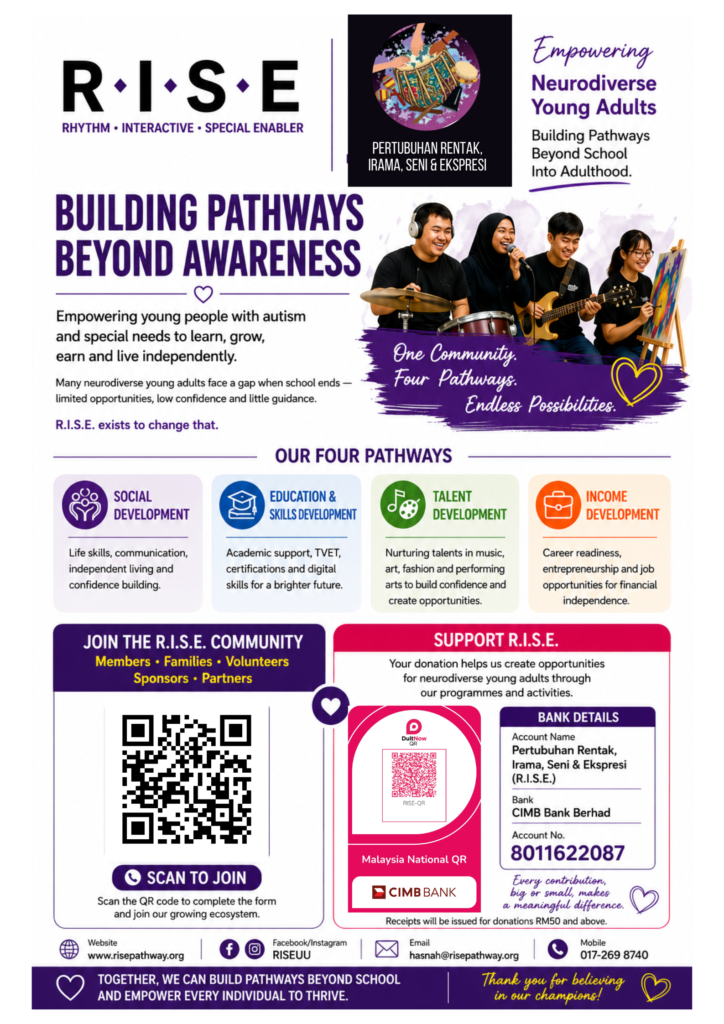
If you believe in what we are trying to achieve through RISE I invite you to walk this journey with us
You can become a member volunteer your time partner with us or contribute towards programmes that empower neurodiverse individuals and their families
Together we can ensure that no family has to walk this journey alone
❤️ Because inclusion begins with all of us

New Malaysia Herald publishes articles, comments and posts from various contributors. We always welcome new content and write up. If you would like to contribute please contact us at : editor@newmalaysiaherald.com
Facebook Comments

Facebook Comments