Malaysia private capital is entering a new phase as shifting global conditions create opportunities to move up the value chain, strengthen the country’s regional position and turn emerging economic challenges into new areas for investment, Deputy Finance Minister Liew Chin Tong said.
KUALA LUMPUR, 03 September 2026 — The Malaysia private capital landscape has an opportunity to play a greater role in accelerating the country’s economic transformation by turning emerging challenges into solutions — and, crucially, into investable opportunities, Deputy Finance Minister Liew Chin Tong said today.
Speaking at the opening of the Malaysia Private Capital Forum 2026 at Menara AFFIN @ TRX, Liew said the global economy was undergoing a fundamental shift from an era focused on efficiency towards one increasingly shaped by resilience.
Malaysia Private Capital at an Inflection Point
He described the current environment as an opportunity for Malaysia to “leapfrog” economically, while noting that the country must be prepared to tackle the challenges accompanying a changing global order.
The forum, organised by the Malaysian Private Capital Association (MPCA) under the theme “Malaysia Forward: Rewiring Capital Flows in an Ascending World”, brought together investors, fund managers, entrepreneurs, policymakers and other players in the private-capital ecosystem.
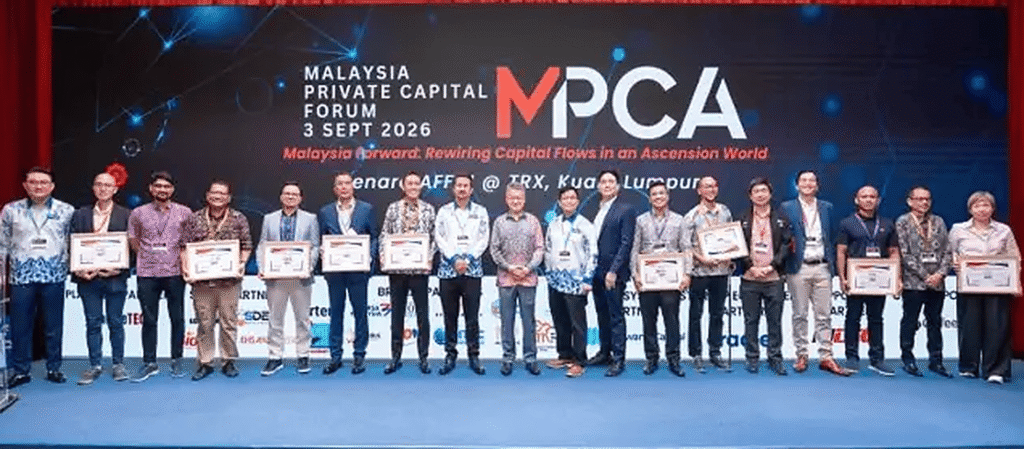
Liew’s keynote followed opening remarks by MPCA Organising Chairman Dr Chris Daniel Wong and MPCA Chairman Ng Sai Kit. The programme then moved into a series of discussions on private credit, institutional investors, venture capital, impact investing and Malaysia’s position as a regional private-capital hub.
From Efficiency to Resilience
Liew’s central argument was that the post-pandemic world is no longer organised around the same assumptions of global efficiency that dominated the previous era.
The move towards resilience, driven partly by geopolitical tensions and more fragmented global supply chains, could create openings for Malaysia.
He pointed to the country’s relatively strong economic performance as evidence of that resilience, with GDP expanding 6% in the second quarter of 2026 and first-half growth reaching 5.7%.
Among the areas contributing to growth, he highlighted Malaysia’s participation in the global artificial intelligence boom, particularly through semiconductors and data centres, alongside palm oil, oil and gas, tourism and services.
But for Liew, the opportunity is not simply to attract more investment into existing industries.
It is to move Malaysia further up the value chain.
From Trading Nation to Technology Nation
Liew said Malaysia needs to continue its transition from a trading nation towards becoming a technology nation.
That means strengthening the country’s position across the semiconductor ecosystem, including outsourced semiconductor assembly and testing (OSAT), advanced packaging, integrated circuit design and semiconductor equipment.
Malaysia’s position as a middle power could also become an advantage as geopolitical tensions increasingly divide the global technology landscape.
Liew described Malaysia as occupying an “indispensable middle” in the global technology and tax landscape, suggesting that the country could serve as a bridge between different economic and technology ecosystems.
Investment Opportunities Beyond Kuala Lumpur
Another theme in Liew’s address was the need to look beyond Kuala Lumpur when considering Malaysia’s next phase of growth.
He identified urban revitalisation as one potential investment opportunity, arguing that instead of continually expanding cities outward, Malaysia should look at rebuilding inner-city areas, repurposing vacant buildings and creating mixed-use urban spaces.
He cited the changing landscape of Kuala Lumpur itself, where the relocation of some financial institutions to newer centres such as Merdeka 118 and Tun Razak Exchange has contributed to vacant buildings in parts of the city. Rather than viewing this solely as a problem, he suggested it could create opportunities for redevelopment.
Liew also called for greater decentralisation of financial expertise.
Penang and Kulim, for example, could develop deeper financial capabilities around technology and semiconductors, while Sarawak’s economic opportunities are closely linked to energy. Johor, meanwhile, has the potential to become a hub for cross-border supply-chain integration with Singapore.
The idea is to bring capital and financial expertise closer to the industries and regions where new opportunities are emerging.
Malaysia’s ASEAN Opportunity
Liew also sees Malaysia’s existing financial infrastructure as an important advantage in the competition for regional capital.
In particular, he pointed to the country’s Islamic finance ecosystem and private-capital networks as platforms that could be leveraged to facilitate regional transactions and investments.
That would position Malaysia not merely as a domestic investment destination, but as a base from which capital can flow into the wider ASEAN market.
The emphasis on regional connectivity also echoed the broader objectives of the forum, where participants examined how Malaysia could strengthen its position within Southeast Asia’s increasingly competitive private-capital landscape.
Demographics: Challenge and Opportunity
Liew also highlighted demographic change as an area where a significant challenge could become an investment opportunity.
Malaysia remains relatively young, with a median age of around 31, but the country is simultaneously moving towards an ageing society.
He offered an unusually simple illustration of the trend: a local factory supplying Malaysia and neighbouring countries is now producing fewer baby diapers and more adult diapers.
For Liew, such changes point towards growing opportunities in healthcare, aged care and public-private investment in services for older Malaysians.
The broader point was that demographic changes should not simply be viewed as future policy burdens. They can also signal where new markets, businesses and investment opportunities will emerge.
From Challenges to Capital
Liew’s message to the private-capital community was ultimately about recognising where Malaysia’s next opportunities may lie — and having the ambition to convert them into investable propositions.
But as the forum’s subsequent sessions would demonstrate, identifying opportunities is only one part of the equation.
MPCA chairman Ng Sai Kit, in his opening remarks, stressed that global capital remains available but has become “more concentrated, more selective and more demanding.” He argued that Malaysia needs not only more deals, but stronger capital formation, credible exit pathways and the ability to return capital to investors.
That sets up perhaps the more difficult question for Malaysia’s private-capital ecosystem: can the opportunities identified today be translated into businesses that can scale, generate returns and ultimately give investors a credible route to exit?
It was a question that would run through many of the discussions that followed. – NMH
Facebook Comments

Facebook Comments