Negeri Sembilan saw Adat first in the form of customary law, Law and Constitution came later for Civilisational Crisis! The current situation further complicate matters.
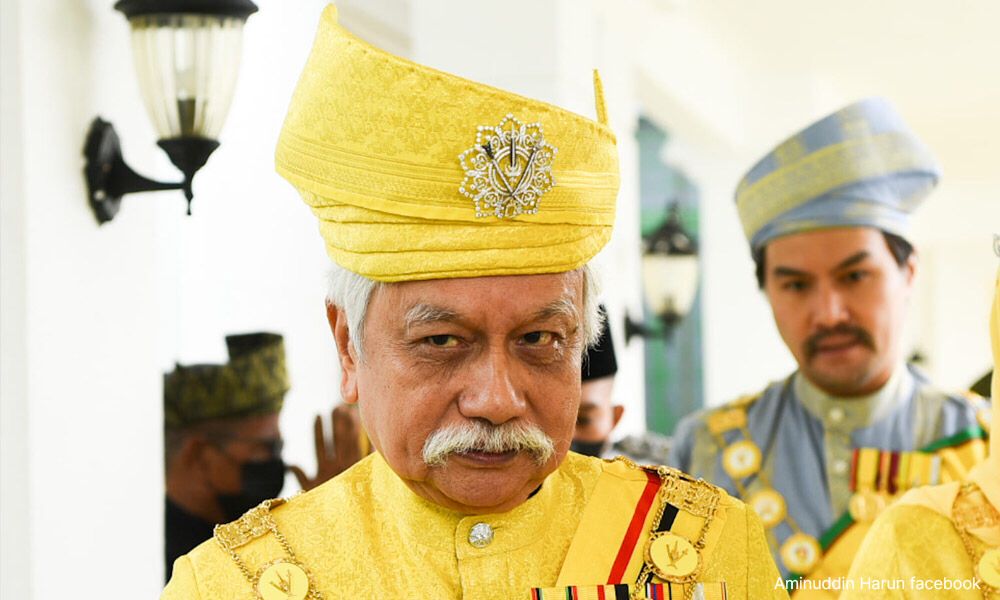
Commentary And Analysis . . . Menteri Besar Datuk Seri Aminuddin Harun, in law, probably cannot advise the Yang di-Pertuan Besar (YDPB), Tuanku Muhriz Tuanku Munawir, on dissolution of the Negeri Sembilan state assembly amidst public standoff with the 4 Undang. The Undang removed the YDPB and also called for the MB’s exit.
The imminent election in Negeri Sembilan will not end the civilisational crisis in the state. The impasse was jurisprudential.
Other issues arise.
The FPtPS (First Past the Post System), inherited from Britain, fell on undemocratic soil in Singapore and Malaysia. It cannot confer consent of the governed for legitimacy and sovereignty.
The EC (Election Commission) can and should hold runoff where no candidate collects at least 51 per cent of the votes counted on D-Day, assuming that at least 51 per cent of the electorate turned up in seats.
Adat Perpatih was law under Article 160 by institutional codification, but subject as per Article 4.
Negeri Sembilan
The crisis in Negeri Sembilan was probably the permanent feature of legal pluralism in Malaysia. It calls for coexistence of systems, reflecting the dharma (duty) of balancing identity, democracy, and the rule of law.
Civilisational Crisis
Again, the resolution, if any, requires runoff reform + modus vivendi (way of co-existence) between Adat and Constitution. Still, that would not end the Civilisational Crisis.
Cause of Action
There should be Originating Summons (OS), the facts not being in dispute, for Declaration by the High Court that FPtPS without runoff violates the spirit of Article 4 on the principle viz. consent of the governed for legitimacy and sovereignty.
The High Court can grant Order of Mandamus which compels the EC on holding runoff within two weeks in constituencies where winner had less than 51 per cent of the votes counted on D-Day, assuming that at least 51 per cent of the electorate turned up in seats.
There should be Declaration that Adat Perpatih, as recorded by the Lembaga Adat, was written law under Article 160.
There should be Judicial Review if the YDPB was removed without hearing, and Undang was suspended. These are breaches of natural justice and Article 4.
There’s Cause of Action against the Menteri Besar being removed by Undang without amendment of the State Constitution.
We know from Ernest Hemingway’s iceberg theory on writing that only one-eighth of meaning was visible.
The visible text was “polls” and “runoff”.
The invisible seven-eighths was the crisis of legitimacy in the form of lawful authority and supreme power expressed as sovereignty.
The visible issue: the FPtPS.
The hidden issue: consent of the governed for legitimacy and sovereignty.
Johor 2022, in digressing a little from Negeri Sembilan, shows that BN (Barisan Nasional) won 40 seats with less than 51 per cent of votes counted in 17 seats, assuming that at least 51 per cent of the electorate turned up in seats. That’s fait accompli (accomplished fate) by plurality. There was no majority.
The Civilisational Crisis was now twofold: Adat Perpatih vs Constitution in Negeri Sembilan, and no mandate under the FPtPS.
The imminent election in Negeri Sembilan cannot cut this Gordian knot. It’s unsolvable problem as they operate on the same undemocratic soil.
The Chronology of Events follow:
Pre-1895: Adat Perpatih governs luak, the riverine territory, and succession in Negeri Sembilan.
Yang di-Pertuan Besar (YDPB) was elected by 4 Undang, the hereditary chiefs.
There was De facto (in practice) law before codification.
1895-1957: British introduce FPtPS (First Past the Post System) for elections. System designed for two-party Britain, but transplanted in multicultural multi-lingual multi-ethnic Singapore and Malaya. There’s mismatch under weltanschauung (world view).
1957: Federal Constitution enacted.
Article 4 declares supremacy.
Article 119 provides elections by FPtPS. There’s no provision for runoff.
Hence, the consent of the governed for legitimacy and sovereignty was assumed, but not measured.
1959: Negeri Sembilan State Constitution recognises YDPB elected by 4 Undang,but silent on removal.
In law, there’s lacuna (gap). It’s not loophole.
1965: National Land Code Section 10 preserves Adat Perpatih for land, based on customary practices or Adat, in Negeri Sembilan. An example of modus vivendi (way of coexistence).
2005: Kerajaan Malaysia v Sagong Tasi affirms Adat rights survive unless expressly extinguished. There’s Principle on continuity.
12 March 2022: Johor State Election. BN (Barisan Nasional) wins 40/56 seats. In 17 seats, winner had less than 51 per cent of votes counted, assuming at least 51 per cent turnout in seats.
There was no consent of the governed for legitimacy and sovereignty. However, the EC (Election Commission) does not hold runoff.
2018-2026: Negeri Sembilan dispute: 4 Undang claim power on removing YDPB, one Undang was suspended, and demand removal of Menteri Besar (MB).
The state government cites Article 16 on the MB.
Again, Polls if called, cannot resolve the Adat Perpatih vs Constitution question in Negeri Sembilan which was plagued by Civilisational Crisis.
In 2026, two crises converge in Negeri Sembilan:
1) the FPtPS, (First Past the Post System) produces, governments without consent of the governed for legitimacy and sovereignty.
2) Adat Perpatih claims institutional codification under Article 160.
The EC has discretion, based on statute and/or good faith on runoffs, but never uses it.
Negeri Sembilan
There are issues in Conflict Between Parties in Dispute in Negeri Sembilan:
Party A: Advocates of Electoral Reforms and Adat Perpatih.
Adat Perpatih
Whether Adat Perpatih was “written law” under Article 160 without Assembly enactment.
Whether FPtPS violates demos (the people) and dharma (duty) in ensuring the consent of the governed for legitimacy and sovereignty.
Whether EC has discretion on holding runoff under Election Offences Act 1954 for curing mandate problem.
Whether 40 seats in Johor 2022, for example, reflect the general will or mere plurality.
Party B: State Government / EC / BN
Whether Article 4 makes Constitution and FPtPS supreme, precluding runoff unless amended.
Whether Article 160 Adat Perpatih claims breach of Article 71 and State Constitution Article 2.
Whether Menteri Besar can only be removed by vote of no-confidence, not by Undang demand.
Whether runoff was beyond powers of the EC without legislative amendment.
There’s Contradiction and Resolution.
Contradiction: Article 119 mandates FPtPS, but the spirit of the age demands consent of the governed for legitimacy and sovereignty.
Article 160 recognises Adat Perpatih but Article 4 makes Constitution supreme.
Resolution: Harmonious construction can read Constitution and give effect for both viz. including Adat Perpatih.
FPtPS, if constitutional, isn’t sacred.
The EC discretion can be read as including runoff as administrative remedy for legitimacy crisis.
Adat Perpatih is law if written, but subject as per Article 4 on procedural fairness. Neither side was wrong; they speak different logic.
Analysis on Issues, Rules and Application.
Issue
Whether Negeri Sembilan polls and Johor 2022 results can confer legitimacy and sovereignty when FPtPS produces undemocratic mandates, whether EC can hold runoff without amendment, whether Adat Perpatih was law under Article 160, and whether this resolves the Civilisational Crisis between customary practices and Constitution.
Rules
Article 4 Federal Constitution: Constitution was supreme. Any law inconsistent was void by the extent of inconsistency with superior law.
Article 119 Federal Constitution: Elections by ballot. FPtPS was method, not entrenched.
Parliament can amend law on elections.
Article 160 Federal Constitution: “Law” includes Adat if written and recognised. The maxim on stand by decided cases requires broad interpretation.
Article 71 Federal Constitution: State Constitution (SC) must provide for Ruler. Negeri Sembilan SC Article 2 ties YDPB with 4 Undang.
Election Offences Act 1954: EC has power on regulating election conduct. Discretion exists but untested for runoff.
Several Common Law Principles apply:
Hear the other side.
Where there are rights, there are remedies.
Express mention excludes others.
There’s reason for binding decisions.
Application
For example, there was no legitimacy in Johor 2022: 40 seats won with less than 51 per cent of votes in 17 seats means the government has no consent of the governed for legitimacy and sovereignty.
Johor isn’t isolated case.
The same phenomenon can be witnessed in Negeri Sembilan, Malacca, Perak, Sabah and Sarawak, among others.
This was just façade viz. outward appearance of democracy. There’s no substance.
In short, FPtPS on undemocratic soil produces rule by few. Polls do not cure this.
EC Runoff Discretion: Article 119 does not prohibit runoff. The EC discretion under Election Offences Act can include runoff within two weeks where no candidate gets at least 51 per cent of votes counted, assuming that at least 51 per cent of the electorate turned up in seats on D-Day.
This is essential condition for consent of the governed for legitimacy and sovereignty.
There’s no amendment needed if framed as administrative rule.
Adat as Law: Lembaga Adat records Undang, Constitution, waris lists, and Tanah Adat registers for satisfying Article 160 “written” test as per Adang Kungan 1997 1 MLJ 418.
Adat was law of it’s own kind.
The Removal of YDPB: Lawful if 4 Undang follow Adat procedure + allowed hearing for the other side.
Suspended Undang must be heard or decision would be rendered void.
Removal of Menteri Besar: No jurisdiction.
Again, Article 16 in the State Constitution governs. Express mention excludes others.
Undang demand for MB’s removal was form of political pressure.
Article 4 Check: Any Adat Perpatih rule violating Article 5 liberty or Article 8 equality can be blue-penciled viz. severed by Federal Court.
This preserves Adat Perpatih while protecting rights. — NMH

Longtime Borneo watcher Joe Fernandez has been writing for many years on both sides of the Southeast Asia Sea. He should not be mistaken for a namesake formerly with the Daily Express in Kota Kinabalu. JF keeps a Blog under FernzTheGreat on the nature of human relationships.
Facebook Comments

Facebook Comments