The opening week of the 1MDB Civil Trial has evolved into more than a dispute over who should bear responsibility for losses allegedly suffered by 1Malaysia Development Berhad (1MDB). While the defence has questioned the basis of the RM24 billion claim in light of substantial recoveries, cross-examination of investigator Richard Templeman, challenges to the reliability of board minutes and objections to portions of Tony Pua’s witness statement have placed the evidential foundation of the plaintiffs’ case under scrutiny.
Plaintiffs Put Najib at the Centre of the 1MDB Civil Trial
KUALA LUMPUR, 6 August 2026 – The opening week of the 1MDB Civil Trial has revealed a significant contrast between the plaintiffs’ case and the approach taken by the defence.
The plaintiffs have alleged that former prime minister Datuk Seri Najib Razak, together with fugitive businessman Low Taek Jho (Jho Low) and several former 1MDB officers, orchestrated a fraudulent scheme that caused losses amounting to approximately US$5.6 billion, with the civil suit seeking about RM24 billion from Najib and the other defendants.
The defence, however, has focused increasingly on a broader question – whether responsibility for the alleged losses can fairly be attributed to any single individual without examining the respective roles of the Board of Directors, senior management and corporate officers involved in the transactions.
That approach was evident in the cross-examination of the plaintiffs’ first witness, former UK investigator Richard Templeman, by counsel GK Ganesan and lead defence counsel Tan Sri Muhammad Shafee Abdullah.
It was also reflected in Shafee’s challenge to portions of former DAP lawmaker Tony Pua’s witness statement later in the week.
GK Ganesan Tests the Investigator’s Findings
Ganesan’s questioning went beyond the conclusions reached by Templeman and examined how those conclusions had been formed.
Templeman agreed that he had never worked for 1MDB, never attended its board or management meetings and had no personal knowledge of discussions involving the company’s senior management during the relevant period.
He also accepted that his witness statement was a retrospective reconstruction based primarily on documents reviewed years after the events rather than matters he had personally observed.
Ganesan’s questioning subsequently examined the distinction between Board authority, management responsibilities and the duties of corporate officers.
Templeman agreed that the individual represented by Ganesan was employed as Director of Investments but was never a member of the Board of Directors.
He further agreed that officers were expected to implement decisions made by their superiors and could not unilaterally override lawful Board resolutions.
The questioning therefore placed the wider corporate decision-making structure under scrutiny rather than focusing solely on the conduct of one individual.
Warnings And The Documentary Trail
Ganesan also referred Templeman to contemporaneous correspondence showing concerns being raised over discrepancies in banking information before funds were remitted.
Templeman accepted that the correspondence reflected an attempt to alert then-chief executive Datuk Shahrol Azral Ibrahim Halmi to the anomaly.
Board minutes were also referred to, including financial warnings concerning loan maturity mismatches, concentration risk, currency exposure and political risks associated with investments.
Templeman accepted those concerns had been presented to the Board and agreed he had not seen documents showing the warnings were subsequently withdrawn or that the Board had been encouraged to disregard them.
Ganesan also walked Templeman through the Good Star, Aabar, Tanore and Options Buyback phases of the alleged transactions.
Templeman agreed that while his witness statement identified transfers involving several defendants, it did not identify the seventh defendant as having personally received funds in any of those phases.
Shafee Challenges The Documentary Record
Shafee’s cross-examination raised a different but complementary set of questions over the reliability of the documentary evidence.
Templeman acknowledged that he was unaware a handwriting expert had previously testified that signatures and handwritten notes attributed to Najib on minutes of 1MDB board meetings were not his.
He also agreed that the minutes contained no record of other individuals being present or participating in the meetings.
The exchange raised questions over how the minutes could reliably establish what had actually taken place during the meetings when they contained no indication of discussion, deliberation or contributions by other attendees.
As put during Shafee’s questioning, the minutes presented an unusual picture – effectively, Najib appearing to have a “monologue” with himself.
The issue is significant because the minutes form part of the documentary material relied upon in the civil claim, while the defence is challenging whether such records can reliably establish the events and decisions they purport to record.
Questions Over The Investigation And Recoveries
Shafee also questioned Templeman over the completeness of his investigation into the movement of funds.
Among the issues raised was approximately US$620 million returned by Najib.
Templeman acknowledged that he had not investigated whether the money, after being returned, had subsequently been rerouted.
That exchange went to whether all subsequent movements of the funds had been examined before conclusions were drawn.
Shafee had also raised the issue of recoveries at a press conference on Tuesday, saying about RM31 billion had been recovered by 1MDB and its subsidiaries – more than the approximately RM24 billion being claimed in the civil suit.
The recovery figure does not, by itself, determine liability. But it forms part of the defence’s wider questioning of the scope and basis of the claim, including concerns over potential double recovery.
Tony Pua’s Evidence Comes Under Scrutiny
The scrutiny of the plaintiffs’ evidence continued when Tony Pua took the witness stand.
Shafee mounted extensive objections to portions of Pua’s witness statement, arguing that parts relied on hearsay, opinion and third-party materials.
The High Court subsequently upheld several objections and ordered numerous portions of the statement to be expunged.
The judge stressed the requirements of relevance and objectivity in witness evidence and cautioned against reliance on third-party media reports where such material could give rise to hearsay concerns.
Among the references ordered removed were passages concerning the arrests of Matthias Chang and Datuk Seri Khairuddin Abu Hassan, as well as references to Bersih rallies.
The plaintiffs argued that media reports had been cited to reinforce and corroborate Pua’s evidence. However, the court ruled that several portions should not remain on the record.
Importantly, the court did not strike out Pua’s entire witness statement – only specific portions were expunged following the defence objections.
What The First Week Of The 1MDB Civil Trial Reveals
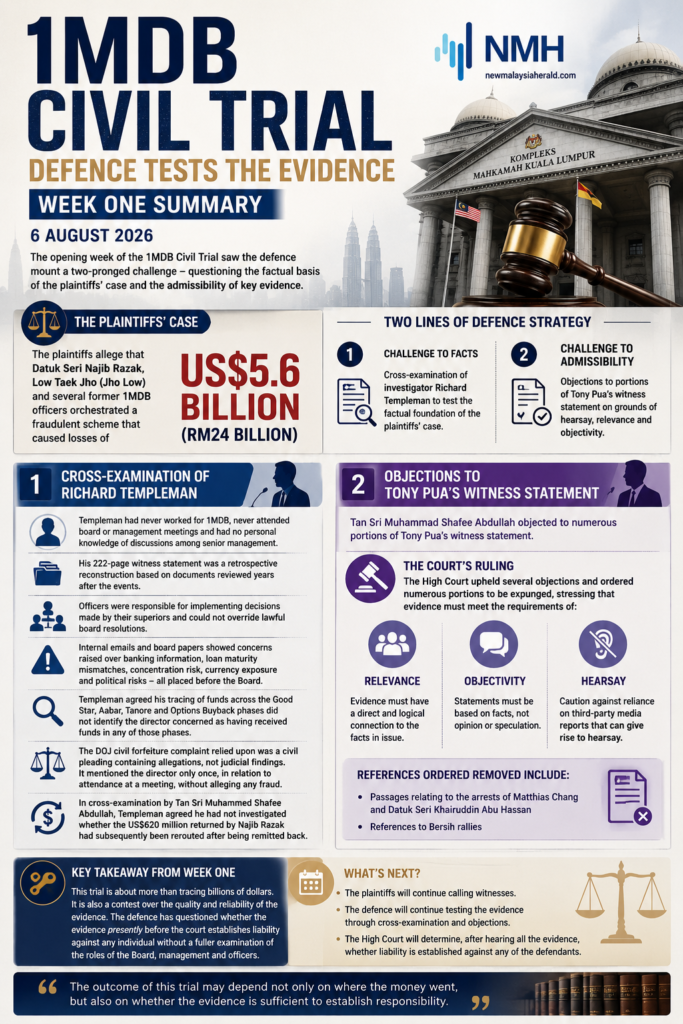
The first week of the 1MDB Civil Trial has therefore been about more than tracing billions of dollars through a complex web of transactions.
It has also become a contest over the quality of the evidence, the methodology used to investigate the transactions and the reliability and admissibility of material relied upon by the plaintiffs.
While the plaintiffs have sought to place Najib at the centre of the alleged fraud and are pursuing a claim of about RM24 billion, the defence has questioned whether the evidence presently before the court establishes liability without a fuller examination of the respective roles played by the Board, management and corporate officers.
Ganeson’s cross-examination tested the investigator’s methodology and the corporate decision-making structure. Shafee’s questioning went further into the reliability of documents used to reconstruct events, the completeness of the fund-tracing exercise and the significance of sums already recovered.
The subsequent objections to Pua’s witness statement added another dimension, with the High Court scrutinising whether portions of the evidence met the requirements of hearsay, relevance and objectivity.
Ultimately, those questions will be determined by the High Court after hearing all the evidence.
For now, however, the opening week suggests that the outcome of the 1MDB Civil Trial may depend not only on where the money went, but also on whether the evidence is sufficient to establish responsibility against those the plaintiffs seek to hold liable – and how the court ultimately assesses the sums already recovered against the losses being claimed. – NMH

Datin Hasnah is the co-founder and CEO of New Malaysia Herald based in Kuala Lumpur, Malaysia.
With an extensive background in mass communication and journalism, she works on building up New Malaysia Herald and it’s partner sites. A tireless and passionate evangalist, she champions autism studies and support groups.
Datin Hasnah is also the Editor in Chief of New Malaysia Herald.
Facebook Comments

Facebook Comments