Impact investing need not mean sacrificing returns, panellists at the Malaysia Private Capital Forum 2026 say, as investors increasingly look beyond ESG labels to measurable outcomes while Malaysia’s alternative financing platforms grapple with exits, governance and repeat capital.
KUALA LUMPUR, 03 September 2026 — Impact investing does not necessarily mean accepting lower returns, with investors increasingly looking at whether environmental and social outcomes – ESGs – can translate into stronger businesses, greater market share and ultimately better financial performance.
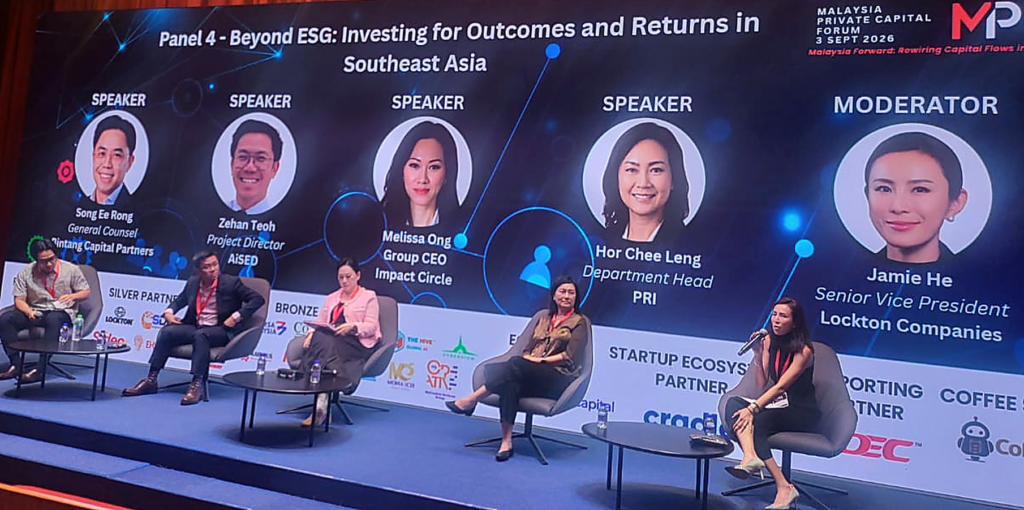
That was one of the key messages from the “Beyond Impact & ESG: Investing for Outcomes and Returns in Southeast Asia” panel at the Malaysia Private Capital Forum 2026, where speakers discussed efforts to establish a clearer relationship between impact outcomes and investment returns.
The session, moderated by Jamie He of Lockton Companies, brought together representatives from PRI, Impact Circle, AiSED and Bintang Capital. The official programme identified the panellists as Chee Leng Hor, Melissa Ong, Zehan Teoh and Ee Rong Song.
Impact Investing: Beyond the Label
One of the speakers said the aim was to generate empirical data showing whether improved environmental performance could translate into financial value through greater brand equity, larger market share and operating-cost savings.
On the social side, greater gender diversity and stronger employee engagement were cited as factors that could improve organisational performance and, eventually, financial returns.
But the speaker was careful not to claim that the relationship had already been conclusively established.
“It’s our own experiment … I don’t have the answer,” the speaker said, adding that the objective was to try different approaches and see how they performed.
That admission was significant: the argument for impact investing was not presented as a settled formula, but as an area where investors are increasingly attempting to establish a measurable link between non-financial outcomes and financial performance.
The panellists also challenged what they described as a misconception that incorporating impact necessarily compromises returns.
Examples were cited of impact funds that had consistently ranked in the top quartile of performance, as well as a Singapore-based impact fund pursuing venture-style returns.
There was, however, recognition that the time required to demonstrate outcomes can vary significantly between sectors.
Agriculture, for example, may require a longer investment horizon than the conventional 10-year fund period before the full impact of an investment can be demonstrated.
From ESG Reporting to Measurable Outcomes
The discussion also suggested that impact investing is increasingly moving beyond the traditional ESG reporting framework.
The panellists pointed to mainstream venture capital investors beginning to identify outcomes aligned with the United Nations Sustainable Development Goals, even when environmental considerations are not the original investment thesis.
An education-technology company in Vietnam was cited as an example. Rather than measuring only the number of students enrolled, investors were looking at improvements in students’ academic performance.
That shift — from counting activities to measuring outcomes — was central to the panel’s argument.
As one speaker put it, going “beyond ESG” does not mean abandoning ESG.
It means moving past labels and reporting requirements towards outcomes that are more concrete and measurable.
The distinction between public and private markets was also raised. Listed companies operate within more standardised ESG disclosure requirements, while private capital investors have greater flexibility to develop their own methods of measuring outcomes.
ECF and P2P: From Access to Capital to Getting a Return
The next discussion turned from impact investing to a more immediate question for Malaysian businesses: what happens after companies get access to alternative capital?
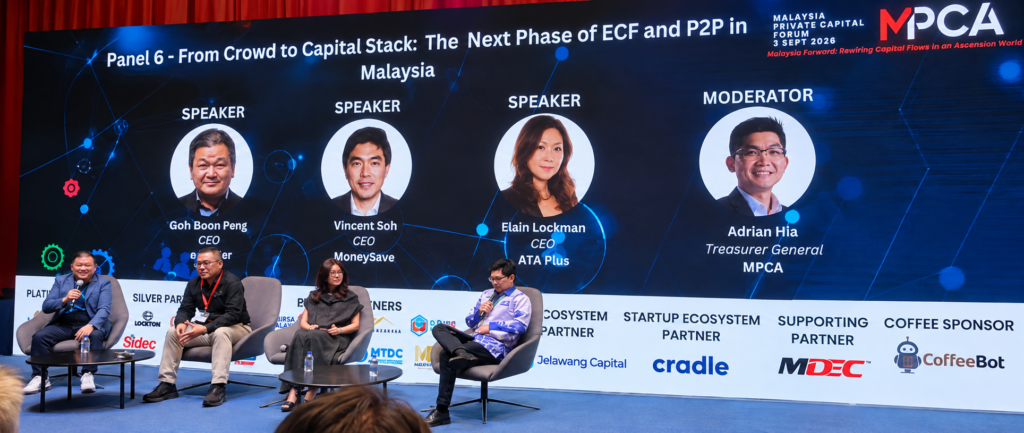
The panel on “From Crowd to Capital Stack: The Next Phase of ECF and P2P in Malaysia” examined the development of equity crowdfunding and peer-to-peer financing after more than a decade of operation.
Malaysia was the first jurisdiction in the Asia-Pacific region to establish an equity crowdfunding framework, with the framework introduced in 2015, while P2P financing was regulated in 2016. The moderator noted that ECF had raised close to RM1 billion through 445 campaigns, while P2P financing had raised RM11.3 billion across 150,000 campaigns.
But the headline numbers mask a significant challenge: exits.
For ECF investors, getting into a company is only the beginning. If there is no credible route to an exit, investors ultimately cannot realise their returns.
Elain Lockman said exits remained one of the biggest challenges after a decade of ECF activity, while Goh Boon Peng said his platform had only seen its first project exit after six years.
Investor education is another concern.
Lockman pointed to competition from other investment products and said retail investors needed to better understand alternative investments, particularly at a time when investment scams were also rising.
The Money Comes With Responsibility
For issuers, the challenge is not simply raising money.
Panellists repeatedly returned to governance, reporting and accountability.
Goh said some SME founders did not initially understand their responsibilities towards investors, while Lockman stressed that money raised from investors was not simply the founders’ own money.
“It’s this hard-earned income of other people’s money that you have to give a return,” she said.
The panel argued that companies need to treat fundraising as part of their broader business strategy rather than something they turn to only when cash runs short.
For companies hoping eventually to move towards an IPO, governance, internal controls, reporting and shareholder responsibilities become even more important.
Goh described efforts by his platform to encourage issuers to participate in CEO roundtables and regular sessions on compliance, internal controls and other aspects of running a company.
Building a Capital Stack
The discussion also highlighted a more mature view of alternative financing: ECF and P2P do not necessarily have to compete with venture capital, private equity or bank financing.
Instead, different forms of capital can work together.
P2P financing, for example, can provide working capital without requiring founders to dilute their equity, while ECF can provide equity capital for longer-term growth.
Vincent Soh said P2P financing could potentially serve a much larger portion of Malaysia’s alternative-debt market, while institutional investors were increasingly participating in the space.
The panellists also highlighted growing cooperation across different parts of the capital stack.
Rather than seeing ECF, P2P, venture capital and private equity as isolated channels, participants said greater collaboration could help fill financing gaps and create a more robust funding ecosystem.
From One-Off Fundraising to the Next Round
Another emerging theme was repeat capital.
Companies that raise money through ECF need to plan beyond their first fundraising round, particularly if they intend to scale.
Goh said his platform had companies that had raised at least twice, with several raising three times, while stressing that issuers should plan for two or three fundraising rounds rather than assuming one campaign would be sufficient.
But repeated fundraising also brings another issue: valuation.
The moderator warned that a high valuation at one stage is meaningless if the company cannot sustain it. A subsequent “down round” can create significant problems for both founders and investors.
The ultimate objective, Goh suggested, should be to build towards a credible destination — potentially an IPO — with valuations and growth expectations grounded in realistic benchmarks.
Taken together, the two afternoon discussions pointed to a common theme.
Whether the investment is driven by impact outcomes or alternative financing, the industry is moving beyond simply asking whether capital can be raised.
The harder questions are becoming: What does the capital achieve? Can those outcomes be measured? Can the business grow? Can investors ultimately realise a return? And can the company become strong enough to attract the next round of capital?
For Malaysia’s evolving private-capital ecosystem, those may be the questions that matter most. – NMH

Datin Hasnah is the co-founder and CEO of New Malaysia Herald based in Kuala Lumpur, Malaysia.
With an extensive background in mass communication and journalism, she works on building up New Malaysia Herald and it’s partner sites. A tireless and passionate evangalist, she champions autism studies and support groups.
Datin Hasnah is also the Editor in Chief of New Malaysia Herald.
Facebook Comments

Facebook Comments